Programme
Friday 4th June
12:30-13:00 Registration
13:00-13:30 Presentation by:
Dr Colin Thompson (St Catherine’s College),
Prof Thomas Earle (Portuguese Sub-Faculty and Centre for Portuguese Language)
Prof Edwin Williamson (Spanish Sub-Faculty)
13:30-14:30 Chair: John Rutherford
From Oppression to Expression: Galician Folk Music finds its True Voice
Sarah Aldred (Strathclyde)
14:30-16:00 Chair: Gabriel Rei-Doval
A canción de acción na Galiza contemporánea
Olga Nogueira (Centre d'Etudes Galiciennes de Paris, Université de Paris III)
As relacións entre música e poesía na Galiza contemporánea. A experiencia "Clave Sónica"
Marta Pérez Pereiro (Consello da Cultura Galega, Santiago de Compostela)
María do Cebreiro Rábade (Centre Dona i Literatura, Universitat de Barcelona)
The 'Nunca Máis' CD (2003): 'Prestige', Protest and Pop
Kirsty Hooper (The Queen's College, Oxford)
16:00-16:15 Coffee
16:15-17:15 Chair: Antoni Bernadó Mansilla
'La canción más hermosa del mundo': Joan Manuel Serrat, the 'reactionary' in his Fortress of Solitude (or instructions about how to build some ruins in Empire)
Álvaro J. Vidal Bouzon (Nottingham)
The self and the alien in Spanish 'Risa-Pop': Comicity, parody and exposure
Carles Gutiérrez (Nottingham)
17:15-18:45 Chair: Robin Fiddian
Montajes para después de una dictadura
Manuel Pulido Mendoza (Universidad de Extremadura)
¡Ay Carmela!
Catalina Buezo Canalejo (Universidad Europea de Madrid)
Popular Music in Contemporary Spanish Cinema: The example of Carlos Saura
Ingrid Simson (Oxford Brookes)
19:00 Dinner
20:30 Concert: Popular Music in the Iberian Peninsula. Music Room (St Catherine's College)
Olga Nogueira and Antonio Visuña
Byron Zeliotis (Guitar)
Carles Gutiérrez (Piano)
Saturday 5th June
9:45-10:45 Chair: Kirsty Hooper
D'aquelas que cantan: Rosalia de Castro in memoriam (ou 'Pissing in a River')
Rocio Martínez Espada (Oxford)
Con voz de muller: Mercedes Peón e Maite Dono
Helena González Fernández (Universitat de Barcelona)
10:45-11:00 Coffee
11:00-12:30 Chair: Eric Southworth
Non popular music- music without words: Rethinking 1964
Enrique Sacau-Ferreira (The Queen's College, Oxford)
"Coplas", poetry and politics, an intoxicating Spanish dolly mixture
Mercedes Carbayo-Abengozar (Nottingham Trent)
"Esto no es sólo una canción" or the role of "canción de autor" and "cantautores" in the Spanish Transition: the cases of Víctor Manuel and Ana Belén
Esther Pérez (Nottingham Trent)
12:30-13:30 Chair: Thomas Earle
Music, a revolutionary tool?
Joaquim Firmino (Universidade Aberta, Lisboa)
13:30 Lunch
14:30-16:00 Chair: Rocio Martínez Espada
A canção de braço dado: o cantar alentejano
João Luís Monteiro Leal (Leeds)
The creation of tradition: Popular Music as a tool in the construction of political ascendancy in Canarian nationalism
Jesús Soria-Núñez (Northumbria)
De 'Fiebre' a 'Esperanza'. From Radio Tarifa to Radio Bemba
Michael Shade (Brighton)
16:00-16:15 Coffee
16:15-17:15 Chair: Paloma García-Bellido
Discursos transnacionales del Pop Español en el tardío siglo XX: ¿bailando salsa?
Silvia Bermúdez (UCSB, California)
17:15 Closing: Dr Gabriel Rei-Doval
Call for Papers
IX FORUM FOR IBERIAN STUDIES
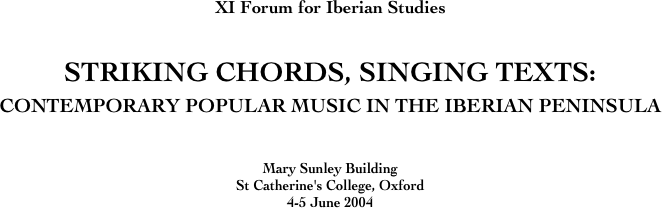
STRIKING CHORDS, SINGING TEXTS: CONTEMPORARY POPULAR MUSIC IN THE IBERIAN PENINSULA
UNIVERSITY OF OXFORD
FACULTY OF MEDIEVAL AND MODERN LANGUAGES AND LITERATURE
From the opening lyrics of “Grândola, Vila Morena” during the Carnations Revolution and “L’Estaca” in the late years of Francoism, to the equally popular, albeit in a different shade of red, “Aserejé”, contemporary music in the Iberian Peninsula proves to be a fertile ground for quite contrasting sound techniques and patterns, linguistic battlefields and even manages to play the occasional role in the political game.
How should we define its popular[qual]ity? Is/was there a common denominator that characterizes such a contrasting array of musical talents and forms?
Contributions from areas such as literary and cultural studies, music, linguistics, history, sociology, anthropology, among others, are welcome. Papers can be presented in English or any of the romance languages of the Iberian Peninsula.
Proposals for 20-minute papers should include a title and an abstract of about 300 words. Please mention any technical requirements and include your name, affiliation and contact details.
Abstracts should be submitted by 1st March 2004 to any of the following:
Rocio Martínez Espada
Faculty of Medieval and Modern Languages
University of Oxford
47 Wellington Square
OX1 2JF Oxford
Gabriel Rei-Doval
The Queen’s College
University of Oxford
OX1 4AW Oxford